
Places to see
We’re so excited to share a few of our favorite places in the area with you.


Pena Palace and the Moorish Castle are iconic, neighboring historic sites in Sintra, Portugal, representing different eras: the Moorish Castle (8th-9th century) is a rugged, ancient fortification built by Moors for defense, with winding walls and towers, while the 19th-century Pena Palace is a vibrant, Romanticist fantasy castle, blending Neo-Gothic, Neo-Manueline, and Neo-Moorish styles as a summer residence, offering stunning views and a stark contrast in architecture and function, though both are accessible from each other via trails.
The Regaleira Palace is the largest building in and common name given to Quinta da Regaleira. Also known as "Palace of the Monteiro Millionaire", a reference to the surname of its former owner, António Augusto Carvalho Monteiro.
Often visited at the same time as the Palacio de Pena.
Cascais is a city nearby that has a nice tourist area where you can walk around and look at the ocean.

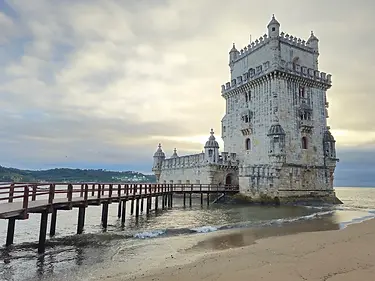
Torre de Belém, officially the Tower of Saint Vincent is a 16th-century fortification located in Lisbon that served as a point of embarkation and disembarkation for Portuguese explorers and as a ceremonial gateway to Lisbon. This tower symbolizes Portugal's maritime and colonial power in early modern Europe.
The pastéis de Belém are one of the most recognized traditional desserts of Portugal. This small puff pastry tart with a creamy and slightly caramelized filling has a texture, aroma, and flavor that will captivate you from the very first bite.


Site of the 1998 world fair.
Walk along the path and observe the Vasco de Gama Bridge (the longest bridge in EUROPE!)
Home of the oceanarium.
Covenant of Tomar. Be transported back in time with amazing architecture from where knights lived and trained.
Castle of Tomar (right next to each other)


One of Portugal’s most beautiful destinations and one of Europe’s best-preserved medieval villages or walled towns. Everywhere you turn is a postcard view, and that has inevitably made it one of the country’s most visited sites. But tourism hasn’t ruined its authenticity, with around two thousand people still living in its pretty whitewashed houses with gothic doorways, potted plants and bougainvillea, all inside the crenellated walls of an ancient castle. Many of those people still dedicate their lives to the traditional handicrafts and the famous local drink, Ginja de Óbidos, sold on the only real street in town, Rua Direita. If you're daring enough, walk around the top of the fort around the city.
The University of Coimbra, one of the oldest in Europe, was classified as a World Heritage Site by UNESCO in 2013. Founded by King Dinis in 1290, originally in Lisbon, the university was definitively transferred to Coimbra in 1537, moving to the Royal Palace buildings.
Fantastic views from the top of the hill.


Fátima, Portugal, is a globally significant Catholic pilgrimage site in central Portugal, famous for the 1917 apparitions of the Virgin Mary to three shepherd children (Lucia, Jacinta, and Francisco Marto) at the Cova da Iria, leading to the vast Sanctuary of Fátima, a complex with the Chapel of the Apparitions, the Basilica of Our Lady of the Rosary, and the modern Basilica of the Most Holy Trinity. Millions visit annually, especially around May 13th and October 13th, to experience its powerful spiritual atmosphere and see sites like the children's homes in nearby Aljustrel.
A scenic area where you can see a panoramic view of Porto and try their famous wines.
Although you won't see the historic Rabelo race (a famous rivalry race of the port wine boats!) you can still observe them as they are docked out on the water and see all the major different manufacturers.


The Porto Cathedral is a Roman Catholic church located in the historical centre of the city of Porto, Portugal. It is one of the city's oldest monuments and one of the most important local Romanesque monuments. Here you can see a beautiful mosaic of azuleijos along the entirety of the wall.
The Stock Exchange Palace is a historical building in Porto, Portugal. The palace was built in the 19th century by the city's Commercial Association in Neoclassical style. It is located in the Infante D. Henrique Square in the historical centre of Porto, designated World Heritage Site by UNESCO.


The São Bento Railway Station is a stunning 19th-century station renowned for its elaborate azulejo tilework in the main vestibule
Livraria Lello in Porto, Portugal, is famous for its stunning Neo-Gothic architecture, intricate woodwork, and iconic red staircase, often cited as an inspiration for J.K. Rowling's Hogwarts, drawing massive crowds as a major tourist attraction and cultural landmark despite its history as a beloved literary haunt.


It's been called “the most beautiful McDonald's in the world”. The restaurant is located at the southeast corner of the Praca de Liberdade (Liberty Square)
Viana do Castelo is a historic coastal city in northern Portugal, located at the mouth of the Lima River along the Atlantic Ocean. Often referred to as the "Mecca of Architecture," the city is celebrated for its blend of medieval charm, Manueline manors, and striking contemporary designs
